Emuruangogolak
Shield volcano · Kenya · 1285m
- Type
- Shield volcano
- Country
- Kenya
- Region
- Eastern Africa / Kenyan Rift Volcanic Province
- Elevation
- 1285m
- Coordinates
- 1.500, 36.330
- Last eruption
- 1910
- Tectonic setting
- Rift zone / Continental crust (> 25 km)
- Landform
- Shield
- Major rock type
- Trachyte / Trachydacite
Geological summary
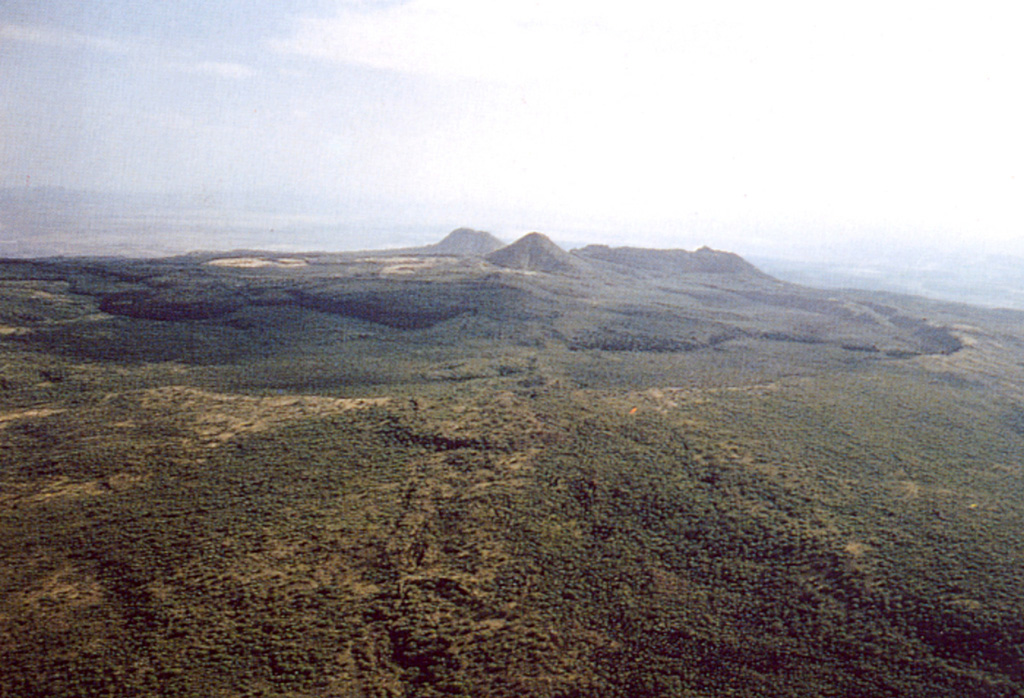
The broad Emuruangogolak shield volcano is situated at a narrow constriction in the Gregory Rift and almost completely straddles it. A 5 x 3.5 km summit caldera formed about 38,000 years ago. Since then trachytic and basaltic lava flows were erupted on the northern and southern flanks and within the caldera. A NNE-SSW-trending chain of lake-filled basaltic maars extends along the floor of the rift from the lower flanks of the volcano. Young lava flows were also erupted from vents along rift valley faults. Well-preserved cones erupted along rift-parallel faults cutting the volcano; the latest eruption produced a trachytic lava flow dated from secular magnetic variation measurements at about the beginning of the 20th century. Fumarolic activity and hot steaming ground occurs along NNE-trending fissures within the caldera and along the lower NW flanks.
From Wikipedia
Emuruangogolak is an active shield volcano straddling the Gregory Rift in Kenya, in Eastern Africa. It has a 3.5-by-5.0-kilometre caldera on its summit. The last known eruption was a trachyte flow which occurred in 1910. Steam vents and fumarolic activity continues from fissures within the caldera and along the flanks of the volcano. Several maar lakes exist in the rift valley adjacent to the volcano. The volcano's summit is at an elevation of 1,285 metres (4,216 ft), and its formation is calculated to have been 38,000 years ago.
Wikipedia · CC BY-SA · Read full article →
Eruption history
Detailed timeline
- 1910 (±50 yrs)VEI 0Geological estimate1910-07-02 – OngoingSouth caldera rim
- 1700 (±100 yrs)VEI 0Geological estimate1700 – OngoingSouth caldera rim
- 1300 (±150 yrs)VEI 0Geological estimate1300 – OngoingNE flank
- 1230 (±150 yrs)VEI 0Geological estimate1230 – OngoingNE flank
- 1160 (±150 yrs)VEI 0Geological estimate1160 – OngoingNE flank
- 1120 (±150 yrs)VEI 0Geological estimate1120 – OngoingNorth flank
- 6550 BCE (±1500 yrs)VEI ?Geological estimateBCE 6550 – OngoingNorth flank
- 8050 BCE (±1000 yrs)VEI ?Geological estimateBCE 8050 – OngoingNorth flank
External links
⚠ For reference only. Not for emergency response.