
St. Andrew Strait

Complex volcano · Papua New Guinea · 270m
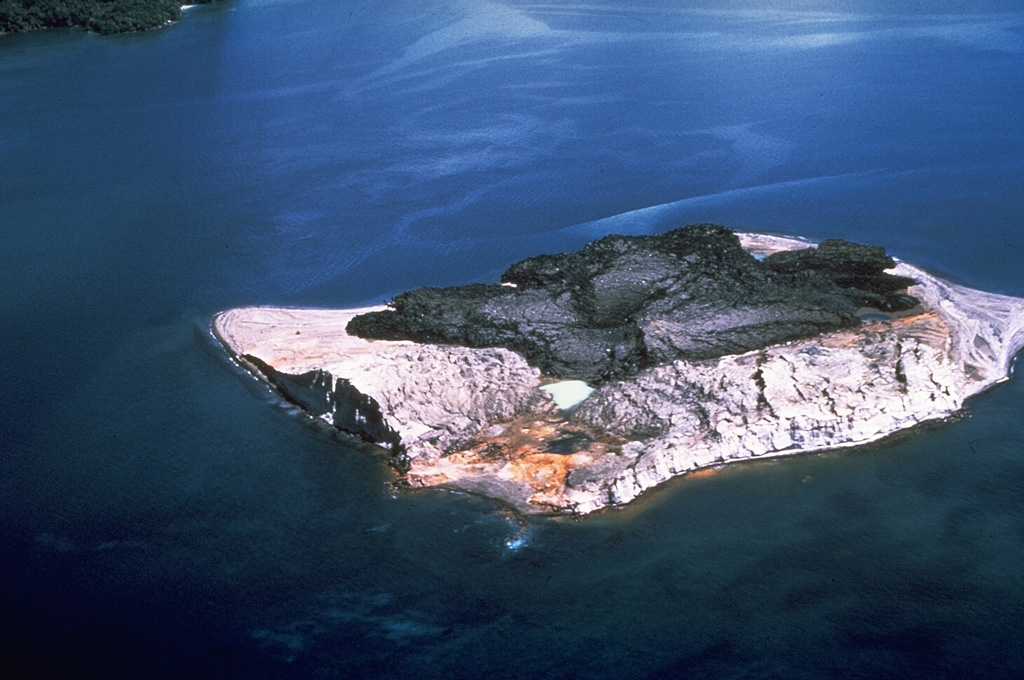
The St. Andrew Strait volcano is located in the Admiralty Islands north of Papua New Guinea. The volcanic complex consists of a series of overlapping Quaternary cones formed by rhyolitic lava flows and pyroclastic deposits on Lou and Tuluman Islands. Volcanism is aligned along a curved arc, extending through the 12-km-long Lou Island. Tuluman Island, seen here from the SW with Lou Island 1.5 km away at the upper left, was formed during a 1953-57 eruption.
The St. Andrew Strait volcano is located in the Admiralty Islands north of Papua New Guinea. The volcanic complex consists of a series of overlapping Quaternary cones formed by rhyolitic lava flows and pyroclastic deposits on Lou and Tuluman Islands. Volcanism is aligned along a curved arc, extending through the 12-km-long Lou Island. Tuluman Island, seen here from the SW with Lou Island 1.5 km away at the upper left, was formed during a 1953-57 eruption. · Photo: Photo by Wally Johnson, 1964 (Australia Bureau of Mineral Resources).
Type
Complex volcano
Country
Papua New Guinea
Region
Southwestern Pacific Volcanic Regions / Bismarck Sea Volcanic Province
Elevation
270m
Coordinates
-2.380, 147.350
Last eruption
1957
Tectonic setting
Subduction zone / Oceanic crust (< 15 km)
Landform
Composite
Major rock type
Rhyolite
Geological summary

The St. Andrew Strait volcano, located in the Admiralty Islands north of Papua New Guinea, consists of a series of overlapping Quaternary cones formed by rhyolitic lava flows and pyroclastic materials on Lou and Tuluman Islands. Volcanism is aligned on a curved arc extending through the 12-km-long Lou Island. The Tuluman Islands, 1.5 km S of Lou Island, were formed during a 1953-1957 eruption. Pam Lin and Pam Mandian Islands farther to the SE along the same arc contain fresh rhyolitic obsidian similar to that found on Tuluman.

From Wikipedia

St. Andrew Strait is a compound volcano in Papua New Guinea that has had eruptions in historical times. The volcano is not linked to any tectonic plates, the volcano is also in an area of very few earthquakes, suggesting that St. Andrew Strait is an Intraplate volcano. It consists of a group of Quaternary volcanic cones that are mainly rhyolitic in composition. The volcanism is curved, suggesting that the volcano has an ancient caldera. The centre of the volcano is Lou Island. Lou island last erupted in 240 BC and 340 AD, both eruptions came from the Bendal volcano. Lou island is the largest eruptive centre of the volcano, with 6 volcanic vents. The Pam Islands also contain fresh deposits. Historic eruptions have come from the Tuluman Islands.

Wikipedia · CC BY-SA · Read full article

Eruption history

Summary (VEI over time)
Click a bar to see individual eruptions
240 BCE~41 BCE · 1 eruptions · max VEI ?159~358 · 1 eruptions · max VEI ?1754~1953 · 3 eruptions · max VEI 2240 BCE35875713551754

Detailed timeline

  1. 1953VEI 2Observed
    1953-06-27 – 1957-01-28
    Tuluman
  2. 1931VEI 0Geological estimate
    1931 – Ongoing
    Tuluman (?)
  3. 1883VEI 2Observed
    1883-03-28 – Ongoing
    Tuluman
  4. 350VEI ?Geological estimate
    350 – Ongoing
    Lou Island (Bedal volcano)
  5. 240 BCE (±100 yrs)VEI ?Geological estimate
    BCE 240 – Ongoing
    Lou Island (Bedal volcano)

External links

⚠ For reference only. Not for emergency response.