Kolokol Group
Stratovolcano · Russia · 1328m
- Type
- Stratovolcano
- Country
- Russia
- Region
- Northwestern Pacific / Kuril Volcanic Arc
- Elevation
- 1328m
- Coordinates
- 46.042, 150.083
- Last eruption
- 1973
- Tectonic setting
- Subduction zone / Intermediate crust (15-25 km)
- Landform
- Composite
- Major rock type
- Andesite / Basaltic Andesite
Geological summary
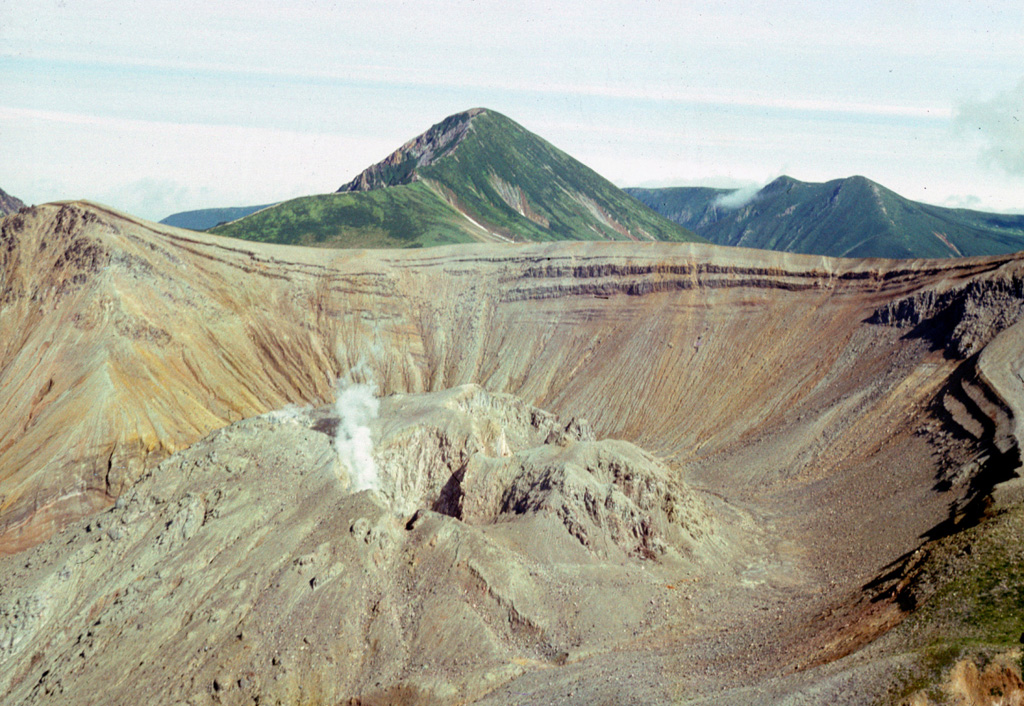
A group of Holocene volcanoes in central Urup Island is named after its most prominent volcano, Kolokol. Berg and Trezubetz volcanoes, flanking Kolokol on the NW, have breached summit calderas partially filled by lava domes. Trezubetz, whose name means "Trident," has an eroded crater rim with three large peaks when seen at sea from the north. Kolokol is sometimes known as Urup-Fuji because of its symmetrical profile. The crater of Kolokol is not well preserved, but there is no evidence of glacial erosion. Several lava flows originate from Kolokol; one of these extends almost to the Sea of Okhotsk coast; a viscous lava flow armoring the SE flank is probably the most recent. Borzov volcano, the oldest of the group, lies to the SW of Kolokol. Eruptions have been observed since the late-18th century. Berg volcano has been most active, but Trezubetz erupted in 1924.
From Wikipedia
Kolokol Group is a group of somma volcanoes located in the central part of Urup Island, Kuril Islands, Russia. The group is named after its highest volcano but also includes volcanoes called Berg, Trezubetz and Borzov. The most active in the group is Berg, while Borzov is the oldest.
Wikipedia · CC BY-SA · Read full article →
Eruption history
Detailed timeline
- 2009VEI 2Geological estimate2009-08-26 – OngoingBerg
- 2005VEI 1Geological estimate2005-07-02 – OngoingBerg
- 1973VEI 1Observed1973-07-25 – 1973-07-26Berg (northern part of lava dome)
- 1970VEI 3Observed1970-02-16 – 1970-03-16Berg
- 1952VEI 2Observed1952-01-15 – OngoingBerg
- 1946VEI 2Observed1946-04-15 – OngoingBerg
- 1940 (±6 yrs)VEI ?Observed1940-07-02 – OngoingBerg
- 1924VEI 2Observed1924-03-13 – OngoingTrezubetz
- 1894VEI 2Observed1894-07-25 – 1894-07-26Berg ?
- 1845VEI 2Observed1845-07-02 – 1846-07-02Berg
- 1780 (±10 yrs)VEI 2Observed1780 – Ongoing
External links
⚠ For reference only. Not for emergency response.