Stepovak Bay Group
Volcanic field · United States · 1633m
- Type
- Volcanic field
- Country
- United States
- Region
- North America / Aleutian Ridge Volcanic Arc
- Elevation
- 1633m
- Coordinates
- 55.917, -160.017
- Last eruption
- Unknown
- Tectonic setting
- Subduction zone / Continental crust (> 25 km)
- Landform
- Cluster
Geological summary
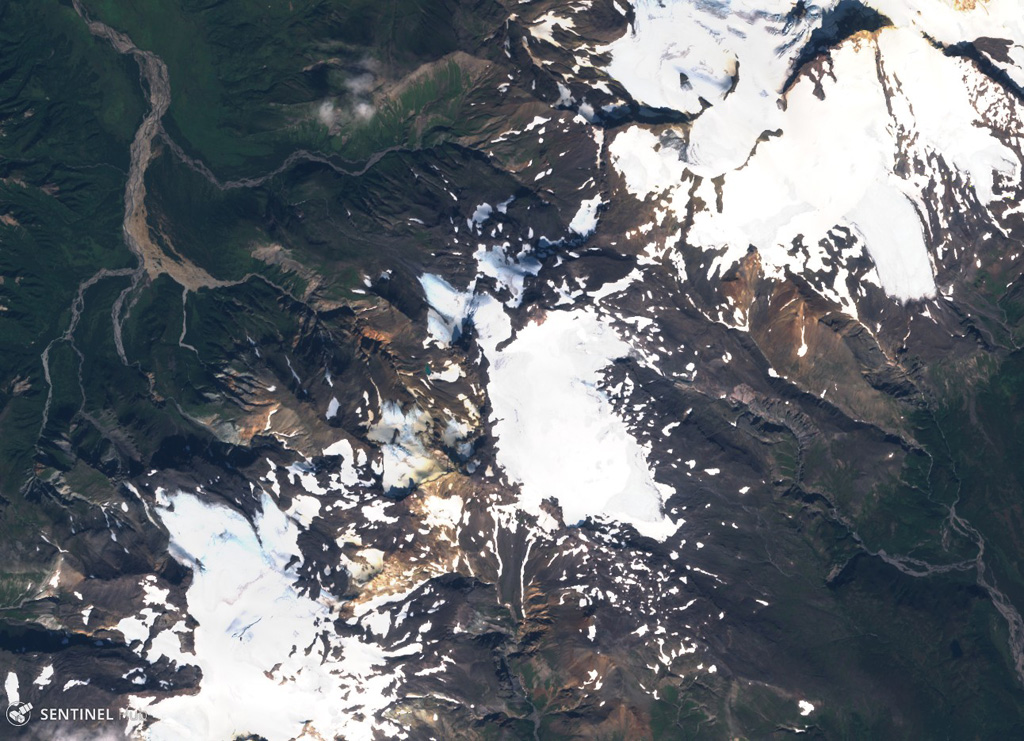
The Stepovak Bay Group is a chain of four cones, extending over a distance of 18 km, just SW of Kupreanof volcano. Stepovak Bay 2 is a cinder cone with a Holocene andesitic lava flow extending initially to the NE, then SE. The Stepovak Bay 3 cinder cone has a thick Holocene lava flow that originated from an ice-filled 300-m-wide crater and entered the same valley as the lava flow from Stepovak Bay 2 (Wilson, 1989); however, Wilson (in Wood and Kienle, 1990) noted uncertainty about this being Holocene activity. Stepovak Bay 4 is a small stratovolcano with Holocene debris flows or block-and-ash flows, and a fumarole has been observed. Stepovak Bay 1, the southwesternmost of the chain is Pleistocene, with K-Ar dates of about 0.53 and 0.4 million years (Wilson, 1989).
Eruption history
Detailed timeline
No eruption records available.
External links
- Not yet on Wikipedia (English). You can contribute on Wikidata.
- 🔗 Smithsonian GVP source page
⚠ For reference only. Not for emergency response.