Atlin Volcanic Field
Pyroclastic cone · Canada · 1880m
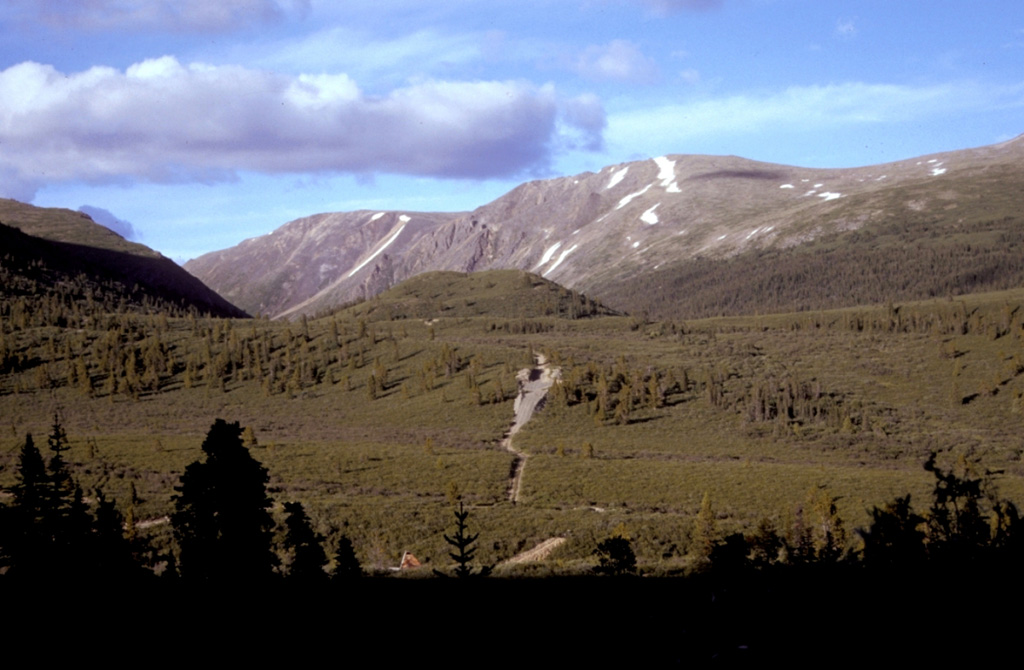
- Type
- Pyroclastic cone
- Country
- Canada
- Region
- North America / Northern Cordilleran Volcanic Province
- Elevation
- 1880m
- Coordinates
- 59.708, -133.358
- Last eruption
- Unknown
- Tectonic setting
- Intraplate / Continental crust (> 25 km)
- Landform
- Cluster
- Major rock type
- Trachybasalt / Tephrite Basanite
Geological summary
The Surprise Lake volcanic field in the Atlin volcanic district is a group of late-Pleistocene to Holocene cinder cones on the Teslin Plateau in NW-most British Columbia, between Atlin Lake on the W and Surprise Lake on the E. The largest volcanic feature is Ruby Mountain (named for the brilliantly colored tephra deposits on the summit and flanks), which has been partially dissected by Pleistocene and post-Wisconsin glaciation. Two basaltic cinder cones at the heads of Cracker and Volcanic Creeks lie within glacially dissected U-shaped valleys and were considered to be post-glacial (Edwards et al., 1996). Placer miners working in the region at the end of the 19th century reported an eruption from the Ruby Mountain area about 80 km S of Gladys Lake (Hickson et al., 1994; Edwards et al., 1996) during which ash fell for several days and the miners were able to work at night due to incandescent glow. However, no field evidence has been found to support any activity from that time, and the report is considered uncertain.
From Wikipedia
The Atlin Volcanic Field, also called the Llangorse Volcanic Field and the Surprise Lake Volcanic Field, is a group of late-Pleistocene to Holocene cinder cones that lies on the Teslin Plateau east of Atlin Lake, Canada. The largest volcanic feature is the 1880-m-high Ruby Mountain, which has been partially dissected by Pleistocene and post-Wisconsin glaciation. Two basaltic cinder cones at the heads of Cracker Creek and Volcanic Creek lie within glacially dissected U-shaped valleys and may be of postglacial age.
Wikipedia · CC BY-SA · Read full article →
Eruption history
Detailed timeline
- 1898VEI ?Geological estimate1898-11-08 – Ongoing
External links
⚠ For reference only. Not for emergency response.