Unnamed submarine volcano in the eastern Pacific Ocean
Northern EPR at 9.8°N
Fissure vent · Undersea Features · 2500m (submarine)
- Type
- Fissure vent
- Country
- Undersea Features
- Region
- Eastern Pacific / Northern East Pacific Rise Volcanic Province
- Elevation
- 2500m (submarine)
- Coordinates
- 9.830, -104.300
- Last eruption
- 2025
- Tectonic setting
- Rift zone / Oceanic crust (< 15 km)
- Landform
- Cluster
- Major rock type
- Basalt / Picro-Basalt
Geological summary
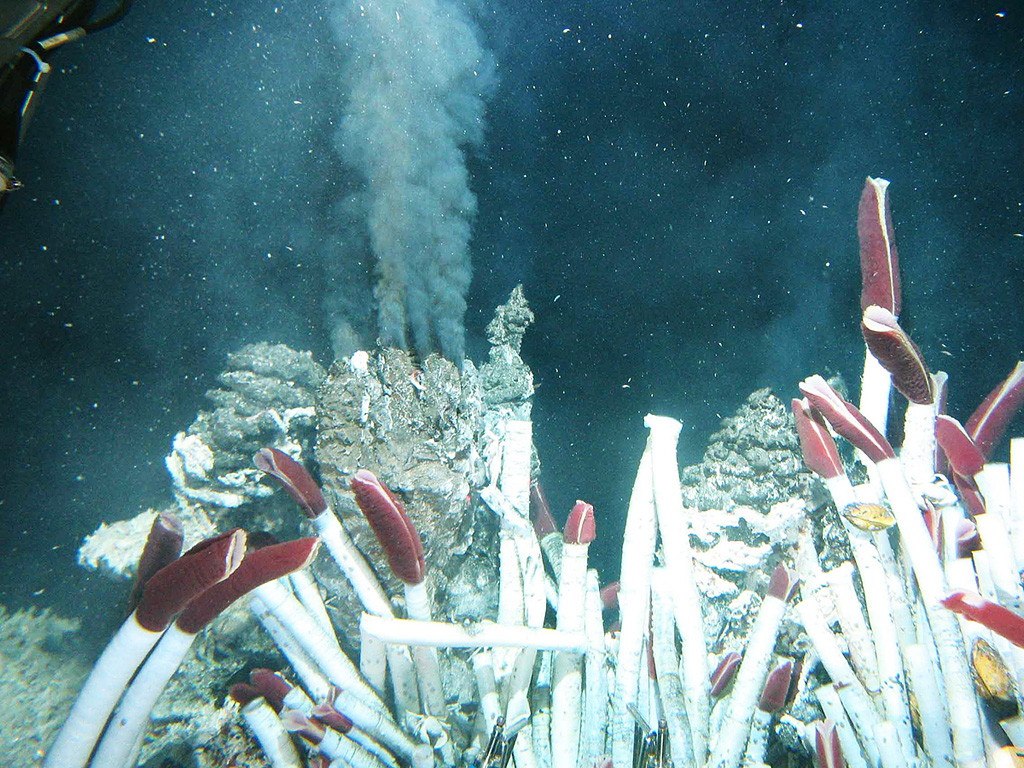
A series of dives with the submersible Alvin in 1991 on the East Pacific Rise at about 9°50'N detected evidence for a very recent, possibly ongoing, eruption. Hot-vent animal communities documented during November-December 1989 had been buried by fresh basaltic lava flows, and the scorched soft tissues of partially buried biota had not yet attracted bottom scavengers. Fresh black smoker chimneys and new lava flows were present. This site is south of the Clipperton Fracture Zone at a depth of about 2,500 m, and about 1,000 km SW of Acapulco, México; the south end of the Lamont Seamount chain is about 10 km NW. This is also the location where lava flows previously estimated as being less than roughly 50 years old had been found. Later dating using very short half-life radionuclides from dredged samples confirmed the young age of the eruption and indicated that another eruptive event had taken place in late 1991 and early 1992. An eruption in 2005-2006 produced lava flows that entrapped previously emplaced seismometers.
Eruption history
Detailed timeline
- 2025VEI 0Observed2025-04-28 – 2025-04-29Tica hydrothermal vent, 9°50’N (9.83°N)
- 2005VEI 0Observed2005-08-16 – 2006-01-16East Pacific Rise (9.8°N)
- 1991VEI 0Geological estimate1991-01-27 – 1991-03-26East Pacific Rise (9.84°N)
- 1991VEI 0Geological estimate1991-12-01 – 1992-02-05East Pacific Rise (9.84°N)
- 1988VEI 0Observed1988-07-02 – OngoingEast Pacific Rise (9.27°N)
- 1950VEI 0Geological estimate1950-07-02 – OngoingEast Pacific Rise (9.87°N)
- 1875VEI 0Geological estimate1875-07-02 – OngoingEast Pacific Rise (9.9°N)
- 1650 (±100 yrs)VEI 0Geological estimate1650 – OngoingEast Pacific Rise (9.82°N)
- 1600 (±150 yrs)VEI 0Geological estimate1600 – OngoingEast Pacific Rise (9.87°N)
- 1200 (±300 yrs)VEI 0Geological estimate1200 – OngoingEast Pacific Rise (9.82°N)
- 950 (±2000 yrs)VEI 0Geological estimate950 – OngoingEast Pacific Rise (9.5°N)
- 850 (±200 yrs)VEI 0Geological estimate850 – OngoingEast Pacific Rise (9.87°N)
- 50 BCE (±2000 yrs)VEI 0Geological estimateBCE 50 – OngoingEast Pacific Rise (9.5°N)
- 1050 BCE (±2000 yrs)VEI 0Geological estimateBCE 1050 – OngoingEast Pacific Rise (9.5°N)
- 2050 BCE (±2000 yrs)VEI 0Geological estimateBCE 2050 – OngoingEast Pacific Rise (9.5°N)
- 3050 BCE (±2000 yrs)VEI 0Geological estimateBCE 3050 – OngoingEPR axis and East of axis
- 4050 BCE (±2000 yrs)VEI 0Geological estimateBCE 4050 – OngoingEast Pacific Rise (9.5°N)
- 5050 BCE (±8000 yrs)VEI 0Geological estimateBCE 5050 – OngoingEPR axis and East and West of axis
External links
- Not yet on Wikipedia (English). You can contribute on Wikidata.
- 🔗 Smithsonian GVP source page
⚠ For reference only. Not for emergency response.