Heidarspordar
Fissure vent · Iceland · 490m
- Type
- Fissure vent
- Country
- Iceland
- Region
- Atlantic Ocean / Iceland Neovolcanic Rift Volcanic Province
- Elevation
- 490m
- Coordinates
- 65.583, -16.817
- Last eruption
- -300
- Tectonic setting
- Rift zone / Oceanic crust (< 15 km)
- Landform
- Cluster
Geological summary
The Heiðarsporðar volcanic system in the Northern Volcanic Zone is about 22 km long, consisting of a fissure swarm and a central volcano. It is embryonic, starting to develop in the marginal area of two adjacent fissure areas, Krafla and Fremrinámar, producing large-volume eruptions. No geothermal activity is present. Magma composition ranges from olivine-tholeiite through tholeiitic basalt and basaltic andesite to dacite. Characteristic activity consists of effusive basaltic eruptions and small predominantly effusive silicic eruptions. It has shown rather low activity in the Holocene but has produced substantial basaltic lava flows. Two eruptive periods have occurred in Holocene time separated by over 8,000 years. The last eruption took place about 2,200 years ago, producing a lava flow covering about 220 km2 and extending 60 km from source.
From Wikipedia
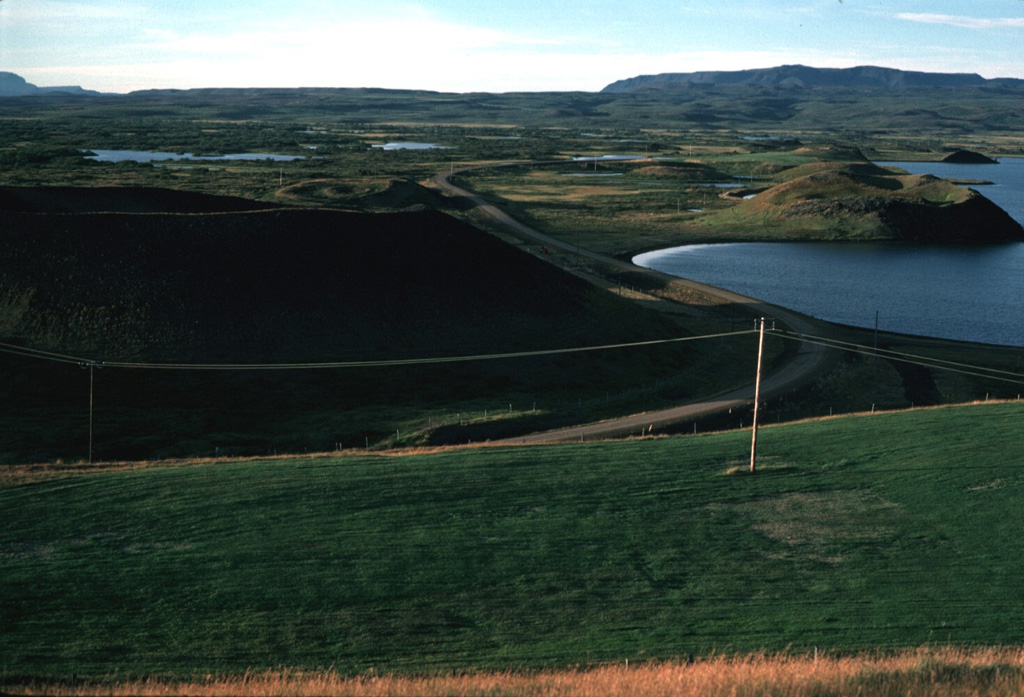
The Heiðarsporðar volcanic system is located in northeast Iceland near Lake Mývatn. It is the source of numerous formations present in and around the lake, particularly in the form of pseudocraters.
Wikipedia · CC BY-SA · Read full article →
Eruption history
Detailed timeline
- 300 BCEVEI 2Geological estimateBCE 300 – OngoingThrengslaborgir-Ludentsborgir crater row
- 4050 BCEVEI 0Geological estimateBCE 4050 – OngoingLudent crater rows
- 5750 BCEVEI 0Geological estimateBCE 5750 – OngoingFjarborg
- 6150 BCEVEI 0Geological estimateBCE 6150 – OngoingDrangagrundahraun
- 6950 BCEVEI 0Geological estimateBCE 6950 – OngoingHraunbunga
- 7400 BCE (±300 yrs)VEI 0Geological estimateBCE 7400 – OngoingHeidarspordur
- 7850 BCEVEI ?Geological estimateBCE 7850 – OngoingLudent, Namafjall-Krofluhals
External links
⚠ For reference only. Not for emergency response.