Montagu Island
Shield volcano · United Kingdom · 1370m
- Type
- Shield volcano
- Country
- United Kingdom
- Region
- Antarctic & Scotia / South Sandwich Volcanic Arc
- Elevation
- 1370m
- Coordinates
- -58.445, -26.374
- Last eruption
- 2007
- Tectonic setting
- Subduction zone / Oceanic crust (< 15 km)
- Landform
- Shield
- Major rock type
- Basalt / Picro-Basalt
Geological summary
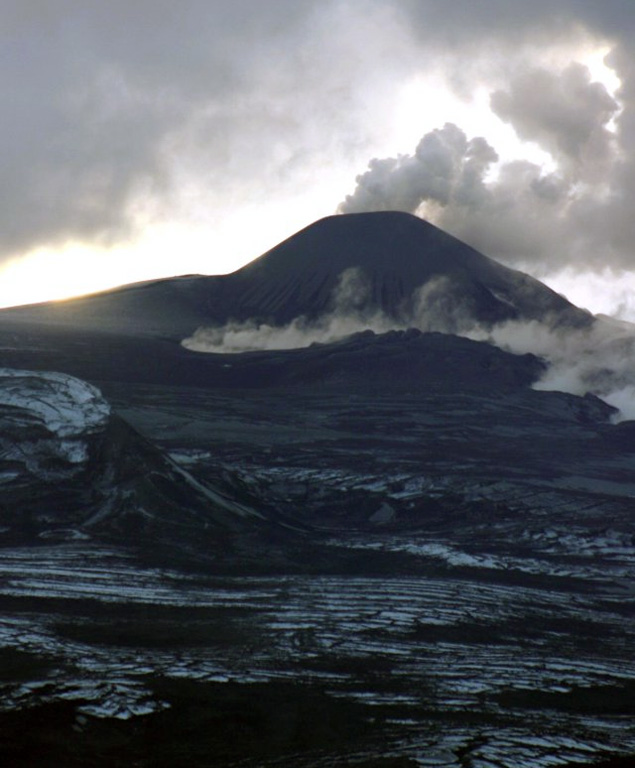
The largest of the South Sandwich Islands, Montagu consists of a massive shield volcano cut by a 6-km-wide ice-filled summit caldera. The summit of the 11 x 15 km island rises about 3,000 m from the sea floor between Bristol and Saunders Islands. Around 90% of the island is ice-covered; glaciers extending to the sea typically form vertical ice cliffs. The name Mount Belinda has been applied both to the high point at the southern end of the summit caldera and to the young central cone. Mount Oceanite, an isolated peak at the SE tip of the island, was the source of lava flows exposed at Mathias Point and Allen Point. There was no record of Holocene activity until MODIS satellite data, beginning in late 2001, revealed thermal anomalies consistent with lava lake activity. Apparent plumes and single anomalous pixels were observed intermittently on AVHRR images from March 1995 to February 1998, possibly indicating earlier volcanic activity.
From Wikipedia
Montagu Island is the largest of the South Sandwich Islands, located in the Scotia Sea off the coast of Antarctica. Almost entirely ice-covered with only sparse rocky outcrops, Montagu consists of a large caldera with a large parasitic cone, Mount Oceanite. Several secondary volcanic cones have formed in the caldera, including Mount Belinda.
Wikipedia · CC BY-SA · Read full article →
Eruption history
Detailed timeline
- 2001VEI 1Observed2001-10-01 – 2007-09-20NW of Mount Belinda
- 1996VEI 1Geological estimate1996-09-01 – Ongoing
External links
⚠ For reference only. Not for emergency response.