Silali
Volcán en escudo · Kenya · 1528 m
- Tipo
- Volcán en escudo
- País
- Kenya
- Región
- África Oriental / Kenyan Rift Volcanic Province
- Altitud
- 1528 m
- Coordenadas
- 1.150, 36.230
- Última erupción
- -5050
- Contexto tectónico
- Rift zone / Continental crust (> 25 km)
- Forma volcánica
- Shield
- Roca principal
- Trachyte / Trachydacite
Resumen geológico
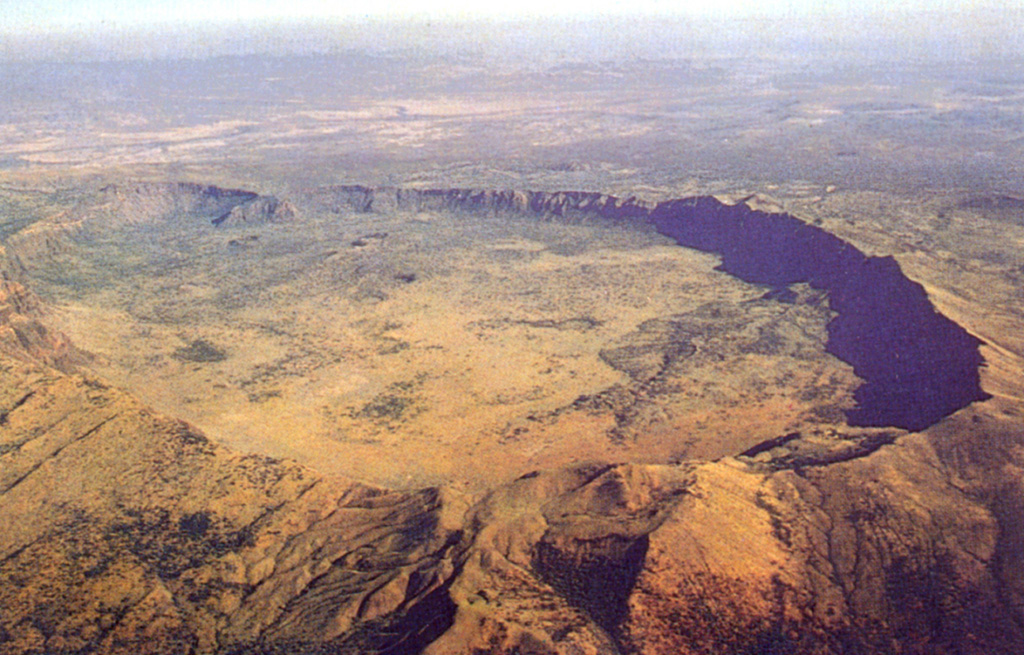
The 30-km-wide Silali trachytic shield volcano, the largest Quaternary volcano in the northern Gregory Rift, completely straddles the East African Rift. The 5 x 8 km summit caldera with 300 m deep walls is thought to have formed incrementally about 63,000 years ago, related to eruption of the Kantenmening basaltic and trachytic lava flows. A series of summit-area lava benches formed by eruptions from circumferential fissures is morphologically similar to Galapagos Islands volcanoes. The N, E, and S flanks are cut by a prominent broad rift zone 10 km wide and 30 km long, with numerous pyroclastic cones. Lava domes on the upper E flank formed during the late Pleistocene and early Holocene, until about 7,000 years ago. Youthful cones are common on the caldera floor and on the N and NE flanks; the youngest lava flows may be little more than a few hundred years old (Williams et al. 1984). Geothermal activity occurs within the caldera and on the upper E flanks.
Resumen de Wikipedia
La montaña Silali es un volcán inactivo del Gregory Rift, cerca de Kapedo, al sur del Valle Suguta, que llega hasta el lago Turkana, a 70 km del lago Baringo. Forma un grupo volcánico con el Paka y el Koposi (Loyamoruk)
Wikipedia · CC BY-SA · Leer artículo completo →
Historial de erupciones
Línea de tiempo detallada
- 5050 a. C. (±2000 años)VEI ?Estimación geológicaBCE 5050 – En cursoUpper east flank
- 6050 a. C. (±3000 años)VEI ?Estimación geológicaBCE 6050 – En cursoEastern part of caldera
- 7050 a. C. (±2000 años)VEI ?Estimación geológicaBCE 7050 – En cursoUpper east flank
Enlaces externos
⚠ Solo como referencia. No apto para respuesta ante emergencias.