Barrier
Barrier, The
Gunung api perisai · Kenya · 1032 m
- Tipe
- Gunung api perisai
- Negara
- Kenya
- Wilayah
- Afrika Timur / Kenyan Rift Volcanic Province
- Ketinggian
- 1032 m
- Koordinat
- 2.320, 36.570
- Letusan terakhir
- 1921
- Kondisi tektonik
- Rift zone / Continental crust (> 25 km)
- Bentuk lahan
- Shield
- Batuan utama
- Trachyte / Trachydacite
Ringkasan geologi
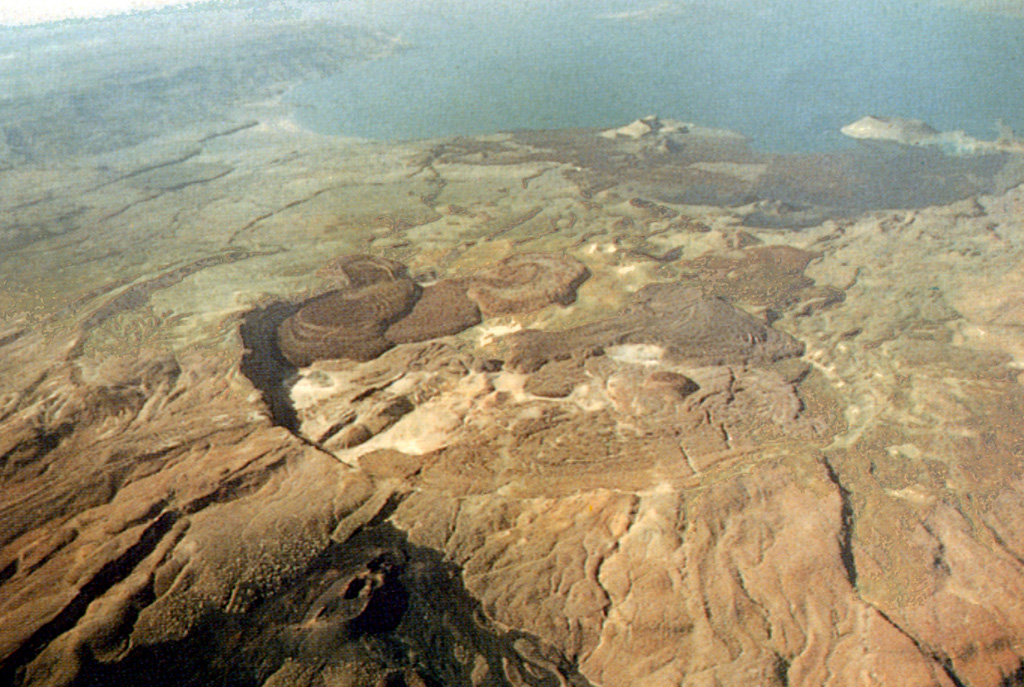
The Barrier volcanic complex separates Lake Turkana from the broad Suguta Trough to the S, the site of a former lake. The volcano is comprised of four overlapping shield volcanoes, with the youngest, Kakorinya, located over the axis of the East African Rift. Kalolenyang volcano lies W of Kakorinya, and Likaiu West and Likaiu East are located to the ENE. A 3.8-km-wide summit caldera was formed at Kakorinya about 92,000 years ago. Youthful-looking trachytic and phonolitic lava domes and flows erupted within the caldera and along its ring fracture fill much of the caldera floor. Early Holocene fissure-related scoria cones and lava flows dot the S and N flanks. Solfataric fields are located within the caldera and on the W and S flanks. Historical eruptions from Teleki's and Andrew's cones on the N and S flanks, respectively, have produced basaltic explosive activity and lava flows during the 19th and 20th centuries.
Ringkasan Wikipedia
Ringkasan InggrisThe Barrier is an active shield volcano located in the north of Kenya. It is last known to have erupted in 1921.
Wikipedia · CC BY-SA · Baca artikel lengkap →
Riwayat letusan
Garis waktu rinci
- 1921VEI 2Teramati1921-12-31 – BerlangsungNorth flank (Teleki)
- 1920 (±3 tahun)VEI ?Perkiraan geologi1920-07-02 – BerlangsungSouth flank (Andrew's Volcano)
- 1917VEI 2Teramati1917-07-02 – BerlangsungAndrew's or Teleki's Volcanoes
- 1906VEI ?Perkiraan geologi1906-07-02 – BerlangsungAndrew's or Teleki's Cones
- 1897VEI 2Teramati1897-05-16 – BerlangsungNorth flank (Teleki) and Likaiu
- 1895VEI 2Teramati1895-07-02 – BerlangsungNorth flank (Teleki's Cone)
- 1888VEI 0Teramati1888-07-02 – BerlangsungNorth flank (Teleki's Cone)
- 1871 (±3 tahun)VEI 2Teramati1871-07-02 – BerlangsungNorth flank (Teleki's Cone)
- 1090 (±50 tahun)VEI 0Perkiraan geologi1090 – BerlangsungNorth flank
- 1050 (±150 tahun)VEI 0Perkiraan geologi1050 – BerlangsungNorth flank
- 1030 (±150 tahun)VEI 0Perkiraan geologi1030 – BerlangsungNorth flank
- 7710 SM (±200 tahun)VEI ?Perkiraan geologiBCE 7710 – BerlangsungNorth (Abili Agituk) and south flanks
Tautan eksternal
⚠ Untuk referensi saja. Bukan untuk tanggap darurat.