Sierra Chichinautzin
Chichinautzin
Campo vulcanico · Mexico · 3938 m
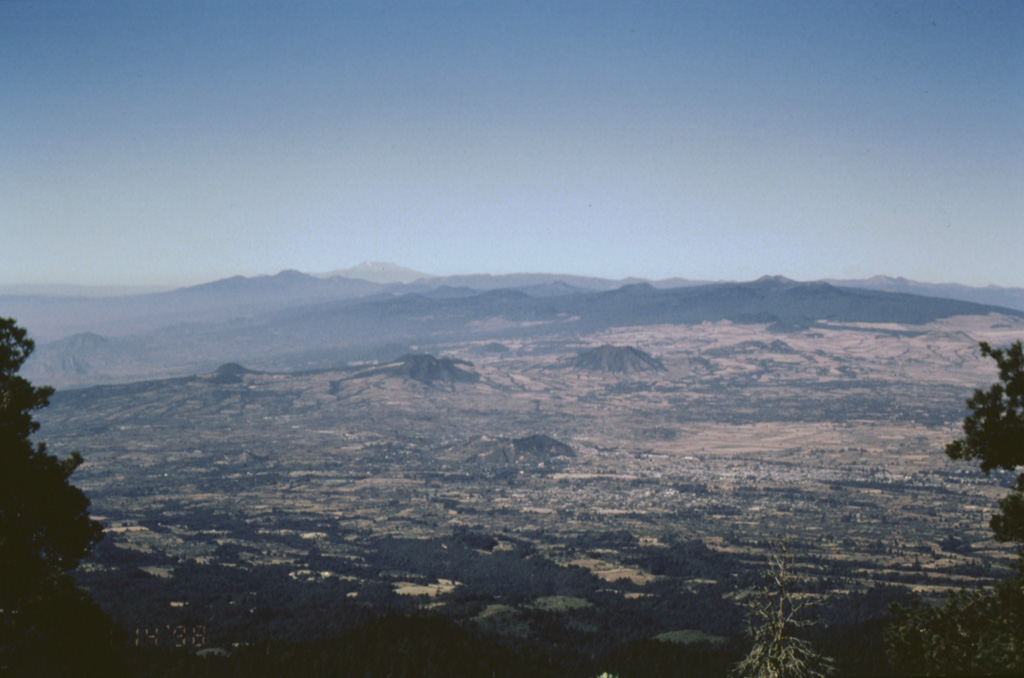
- Tipo
- Campo vulcanico
- Paese
- Mexico
- Regione
- America Centrale e Caraibi / Trans-Mexican Volcanic Arc
- Altitudine
- 3938 m
- Coordinate
- 19.139, -99.160
- Ultima eruzione
- 399
- Contesto tettonico
- Subduction zone / Continental crust (> 25 km)
- Forma vulcanica
- Cluster
- Roccia principale
- Andesite / Basaltic Andesite
Sintesi geologica
The massive Chichinautzin volcanic field extends over an 88 km E-W area immediately south of Mexico City. The Sierra Chichinautzin, formed primarily of overlapping small cinder cones and shield volcanoes, creates a broad topographic barrier at the southern end of the Basin of Mexico that extends from the E flank of Nevado de Toluca to the W flank of Iztaccíhuatl. The volcanic field contains more than 220 Pleistocene-to-Holocene monogenetic vents. The best-known eruption occurred about 1,670 radiocarbon years ago (400 CE) from the Xitle scoria cone, NE of the Volcán Ajusco lava dome complex, which forms the highest peak of the Sierra Chichinautzin. The Xitle eruption produced a massive basaltic tube-fed lava flow that covered agricultural lands as well as pyramids and other structures of Cuicuilco and adjacent prehispanic urban centers. The southern part of Mexico City and the National University of México lie atop the distal end of the 13-km-long lava flow.
Sintesi da Wikipedia
Riassunto in ingleseThe Sierra Chichinautzin volcanic field, also known as El Pedegral, is located in the Trans-Mexican Volcanic Belt, approximately 350 kilometres (220 mi) from where the Cocos Plate subducts beneath the North American Plate.
Wikipedia · CC BY-SA · Leggi l'articolo completo →
Storia delle eruzioni
Cronologia dettagliata
- 399 (±149 anni)VEI 3Stima geologica399 – In corsoXitle
- 203 (±131 anni)VEI 3Stima geologica203 – In corsoChichinautzin
- 2238 a.C. (±1413 anni)VEI 3Stima geologicaBCE 2238 – In corsoGuespalapa
- 4250 a.C. (±75 anni)VEI 3Stima geologicaBCE 4250 – In corsoTláloc
- 5840 a.C. (±500 anni)VEI ?Stima geologicaBCE 5840 – In corsoCuauhtzin
- 7340 a.C. (±1050 anni)VEI 0Stima geologicaBCE 7340 – In corsoCerro Tetepetl
- 7370 a.C. (±300 anni)VEI 4Stima geologicaBCE 7370 – In corsoTres Cruces
- 7930 a.C. (±500 anni)VEI 3Stima geologicaBCE 7930 – In corsoVolcán Pelado
Link esterni
⚠ Solo a scopo informativo. Non adatto a situazioni di emergenza.