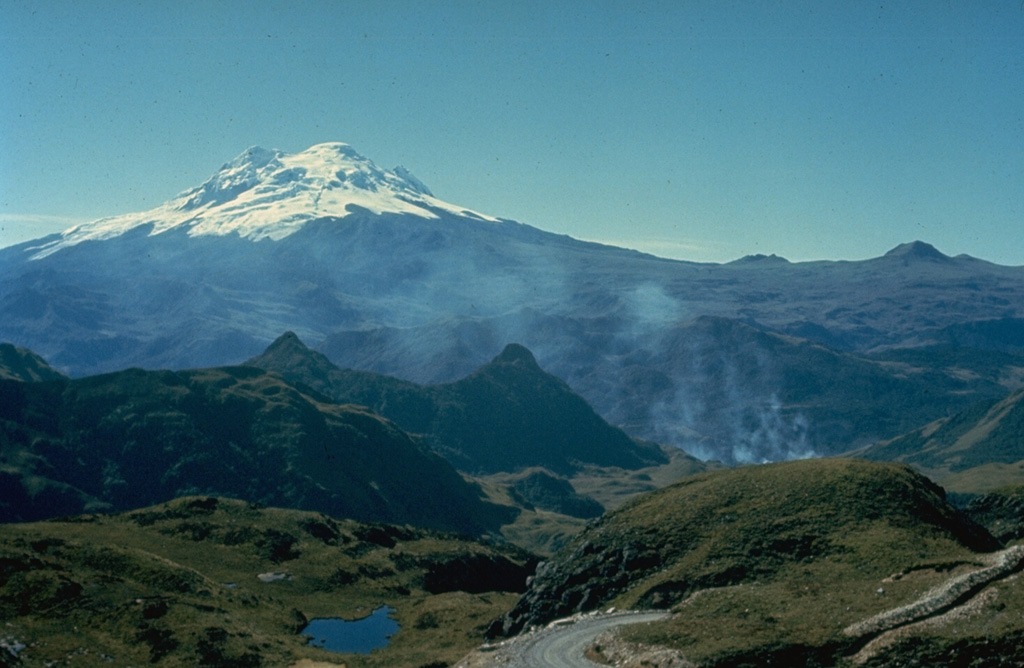
Chacana
Caldera · Ecuador · 4643 m
- Tipo
- Caldera
- Paese
- Ecuador
- Regione
- Sud America / Northern Andean Volcanic Arc
- Altitudine
- 4643 m
- Coordinate
- -0.375, -78.250
- Ultima eruzione
- 1773
- Contesto tettonico
- Subduction zone / Continental crust (> 25 km)
- Forma vulcanica
- Caldera
- Roccia principale
- Rhyolite
Sintesi geologica
Chacana is a massive, eroded caldera complex of Pliocene-Holocene age that forms one of the largest rhyolitic centers of the northern Andes. The caldera is 32 km long in the N-S direction and 18-24 km wide E-W. It was constructed during three cycles of andesitic-to-rhyolitic volcanism, with major eruptions about 240,000, 180,00, and 160,000 years ago. Dacitic lava flows were erupted from caldera-floor fissures between about 30,000 and 21,000 years ago. Numerous lava domes were constructed within the caldera, which has been the source of frequent explosive eruptions throughout the Holocene as well as historical lava flows during the 18th century. The massive Antisana stratovolcano was constructed immediately to the SE.
Sintesi da Wikipedia
Riassunto in ingleseChacana is a large 32-km long - 18–24 km wide caldera that has erupted in historical times. It forms one of the largest rhyolite centers in the Northern Andes with major eruptions over the past 240,000, 180,00, and 160,000 years ago and has had andesitic-rhyolitic volcanism. With dacitic lava flows continuing into historical times. Lava domes were also constructed in the Holocene. Chacana is located 30 km from Quito and the large Antisana volcano is constructed to the southeast.
Wikipedia · CC BY-SA · Leggi l'articolo completo →
Storia delle eruzioni
Cronologia dettagliata
- 1773VEI 0Osservata1773 – In corsoSouth part of caldera
- 1760VEI 0Osservata1760 – In corsoSW flank
- 50 a.C.VEI ?Stima geologicaBCE 50 – In corso
- 1580 a.C. (±10 anni)VEI ?Stima geologicaBCE 1580 – In corso
- 8050 a.C.VEI ?Stima geologicaBCE 8050 – In corso
Link esterni
⚠ Solo a scopo informativo. Non adatto a situazioni di emergenza.